PCSO Lotto Results Oct 28, 2026: 5 Myths That Cost Bettors Money
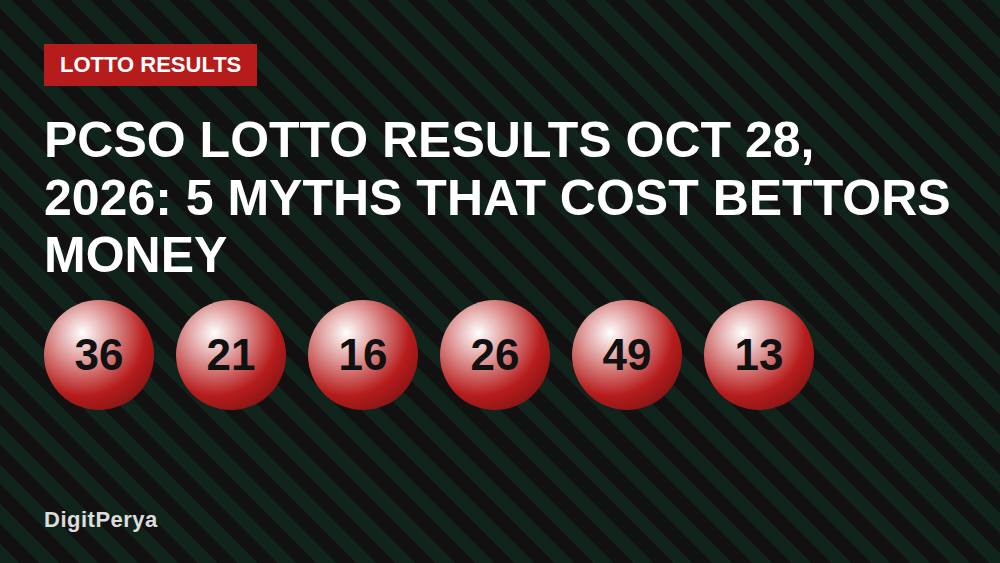
The October 28, 2026 Numbers, Straight From the Draw
Before the myth-busting, here is what actually dropped on Wednesday night. The 6/55 Grand Lotto drew 36-21-16-26-49-13 with a jackpot of P312,102,304.83. The 6/45 Mega Lotto came out as 19-40-37-01-14-29, carrying the standard P15,000,000.00 minimum pot. The 9:00 PM 4D Lotto result was 1-3-8-4, with a P69,826.00 prize pool. There were no jackpot winners recorded across all three games.
The table above lays out every combination and prize figure in full, so we will not repeat them line by line here. What matters is the shape of the night: a nine-figure Grand Lotto pot rolling over untouched, a Mega Lotto jackpot reset to its floor, and a 4D draw where nobody nailed the four-digit sequence. That is a clean, unremarkable set of results on paper. But when you line it up against the stories bettors tell each other at the outlet counter, it becomes a useful myth-busting dossier.
We have been tracking PCSO draws long enough to know which myths survive because they feel good, not because they hold up to scrutiny. So let us put five of the most persistent ones on the table and see what October 28, 2026 has to say about them.
| Game | Winning combination | Jackpot (PHP) | Winners |
|---|---|---|---|
| 6/55 Grand Lotto | 36-21-16-26-49-13 | 312,102,304.83 | |
| 6/45 Mega Lotto | 19-40-37-01-14-29 | 15,000,000.00 | |
| 4D Lotto 9:00 PM | 1-3-8-4 | 69,826.00 |
Myth 1: "Nobody Won, So the Machine Was Cold"
This is the oldest one in the book. A draw with zero jackpot winners gets labelled "cold," as if the balls owe us something after a dry spell. Look at the Grand Lotto result again: no winner on a P312-million pot. Under the "hot and cold" theory, that should mean the next draw is due to pay out.
It is not. Every 6/55 draw is an independent event with the same 1-in-28,989,675 odds against a single ticket taking the jackpot. The machine does not retain memory of October 28. What actually happened is simpler and more brutal: the pot rolled over, which means the next scheduled draw will carry a bigger jackpot, and the number of tickets sold will climb as the figure gets fatter. More tickets means more combinations covered, nothing more.
Here is the practical angle. A rollover inflates the prize, not the probability. If you buy one ticket for the next Grand Lotto draw, your odds are identical to what they were on October 28, 2026, no matter how many times the number flashes in a headline.
Jackpot size changes the payout. It never changes the math.
The only thing you can control is spend. Set a weekly lotto allocation — P200 to P500 is where most disciplined players we talk to sit — and treat a rollover as entertainment value, not as a signal to double down.
Myth 2: "Sequential and Low Numbers Never Come Up"
Plenty of players avoid a combination like 1-2-3-4-5-6 because they assume the draw would never produce something so tidy. Then they look at the Mega Lotto result for October 28 — 19-40-37-01-14-29 — and notice the 01 sitting right there at the front, plus the 4D draw landing on 1-3-8-4.
Low numbers appear constantly. On this particular night, the 4D result is about as "low" as four digits get, and it still produced a P69,826.00 prize pool with no top winner. The reason sequential and low combinations are rare is pure combinatorics: there are vastly more scattered combinations than ordered ones, so the odds of any specific tidy sequence are the same tiny fraction as any other specific sequence.
That means the 1-in-10,000 odds on a single 4D pick apply whether you choose 1-3-8-4 or 7-2-9-5. Both are one combination out of ten thousand. PCSO pays a fixed P10,000 for a winning 4D Straight bet at the standard P10 minimum, so the payout does not care how pretty your digits look.
What this should actually change is your combination strategy, which is to say: stop filtering. Players who skip "birthday-heavy" rows or refuse to play 01 cut their coverage for no mathematical reason. If anything, avoiding popular number patterns is a smarter play — not because they are less likely to hit, but because sharing a jackpot with forty other winners is the real risk to your payout.
Myth 3: "Bigger Bets Buy Better Odds"
No. Adding zeroes to your ticket buys more combinations, not better ones. If you spend P1,000 instead of P100 on the 6/45 Mega Lotto, you are buying roughly 200 combinations at P10 per line rather than 20, and your odds improve proportionally — from about 1 in 8,145,060 to about 1 in 407,253 per line-set. That is a real improvement in coverage, but it is still a lottery, and it is still a losing proposition in expected-value terms.
The distinction matters because the phrase "better odds" gets used loosely. Your probability of winning goes up with spend. Your probability of winning per peso does not. Ever.
The Mega Lotto jackpot on October 28 sat at its P15,000,000.00 floor because the previous cycle had reset. A floor-level jackpot is the worst value moment to increase your stake, since the prize-to-odds ratio is at its thinnest. If you want to spend more, do it when the pot is inflated by rollovers — the expected value is still negative, but at least the payout is fatter.
For readers who also play online casino games between draws, the same discipline applies. A licensed operator under a PAGCOR-issued offshore licence typically requires 1x wagering on slot deposits and 30x to 40x on bonus credits, with minimum deposits around P500 and e-wallet withdrawals settling in 1 to 3 hours. Compare that to a lotto ticket with a 1-in-29-million shot and the difference in how far your peso stretches becomes obvious.
Myth 4: "The 9:00 PM Draw Is the Lucky Slot"
There is a stubborn belief that the evening 4D draw pays better because more people are off work and playing. The October 28, 2026 4D result — 1-3-8-4 with a P69,826.00 prize pool — is a good moment to dismantle that.
Prize pools in 4D are not fixed jackpots. They are pari-mutuel, meaning the pool is built from sales and paid out according to how many winners there are across the Straight, Rumble, and other bet types. A draw with no top winner does not mean the evening is unlucky. It means the money gets distributed to lower-tier winners and the remainder rolls into the next pool depending on PCSO's structure for that game.
What is real is the effect of sales volume on your share. Bigger sales make a bigger pool, but if lots of people play the same "lucky" combination, you split the prize. The winning move for 4D is not chasing a time slot — it is picking combinations that other players ignore. A draw like 1-3-8-4 may look random, but low-digit sequences attract a fair share of casual tickets, so the payout per winner can be thinner than an odd-looking combination with the same hit rate.
If you are going to play 4D, play it as a small-stakes game. At P10 per combination, it is the cheapest PCSO game to cover meaningfully, and a Straight hit pays P10,000 on that P10. That is a 1,000x multiplier on a single line — competitive with the best slot payouts, and you do not have to clear a 35x wagering requirement to withdraw it.
Myth 5: "Past Results Predict the Next Draw"
The most seductive myth is pattern-reading. After October 28, someone will inevitably note that the Grand Lotto combo started with 36 and ended with 13 and claim they saw it coming. Nobody did.
Let us be concrete about why the analysis fails. The 6/55 Grand Lotto has 28,989,675 possible combinations. Drawing 36-21-16-26-49-13 on one night tells you exactly one thing: that combination is now off the board. It does not raise the probability of 13 appearing again, and it does not lower it. The balls have no memory of the five draws that came before, and there is no mechanism — mechanical or digital — that carries momentum between draws.
Where pattern-hunting does pay off is in behavioural terms. Track which combinations are popular and avoid them. Hundreds of players build tickets from calendar dates, so numbers 1 through 31 are over-covered. The Grand Lotto numbers above include four values inside that popular range and two above it — the higher digits, 36 and 49, tend to appear on fewer tickets. If you want to maximize what you take home when you win, lean into high numbers and avoid birthday-style rows.
That is the honest version of "strategy" in lotto. It does not improve your odds of winning. It improves your odds of not splitting the pot when you do.
What to Do With the October 28 Results
Three practical takeaways for the next draw cycle.
Track the rollover, not the streak. The Grand Lotto pot at P312,102,304.83 carries into the next draw. That is the number to watch, because a fatter jackpot is the only variable that meaningfully changes the value of your ticket. Set a threshold — say, only play Grand Lotto when the pot clears P200 million — and stick to it.
Treat each game separately. The Mega Lotto reset to P15,000,000.00 and the 4D pool sat at P69,826.00. These games have entirely different odds structures (1 in 8.1 million versus 1 in 10,000), so do not carry a Grand Lotto mentality into a 4D ticket or vice versa. 4D is a small, frequent, cheap game. 6/55 is a rare, high-variance lottery. Budget for them differently.
Play within a licensed, regulated structure. All PCSO games operate under the agency's congressional franchise, and winnings above P10,000 are subject to the 20% final tax on prizes. That is a real deduction on a nine-figure jackpot, so plan for it — a P312 million pot nets roughly P249.7 million after tax. Knowing the net figure before you buy keeps your expectations calibrated.
For players who also use online platforms, stick to operators holding a valid PAGCOR licence, verify the licence number is displayed in the site footer, and check that withdrawal terms (processing time, minimum withdrawal, wagering) are stated before you deposit. That is the boring part of the hobby, and it is the part that separates people who play for years from people who blow their budget in a month.
Check back after every Monday, Wednesday, and Saturday draw for the updated PCSO results and our myth-versus-fact breakdown of what the numbers actually mean.